Whether you are a football fan or not, you have probably heard about the FIFA World Cup 2026. Packed stadiums, dramatic goals, fans in painted jerseys screaming at the top of their lungs.
For most people, it is simply a football tournament, but for logistics professionals, it is one of the most complex event logistics in the world.
Before kickoff, stadiums must be stocked with food and merchandise, equipment installed, and operations prepared to handle peak demand. All of this is coordinated through careful event logistics management.
The World Cup lasts about a month, but the logistics behind it take years. Let’s step into the supply chain behind the World Cup and explore what it takes to run the world’s biggest football tournament.
Contents:
- Event logistics for major events
- The World Cup supply chain
- Business impact of the World Cup
- Planning the tournament supply chain
- Why simulation matters for event logistics
- Tools for supply chain planning
- The logistics victory nobody notices
Event logistics that make major events possible
At its core, any major event is a logistics project.
Concert tours, Olympic Games, Formula 1 races—none of them work without a carefully orchestrated flow of goods, equipment, people, and services. Everything must arrive at the right place, at the right time, and in the right quantity.
And the margin for error is basically zero.
- If food deliveries are late, fans notice immediately.
- If transport systems fail, people miss matches.
- If broadcast equipment doesn’t arrive on time, billions of viewers see nothing.
Events compress massive operational complexity into a very small window of time. For a few hours, a stadium becomes a temporary city with tens of thousands of people who all need food, security, transportation, and services at exactly the same moment.
That’s event logistics management.
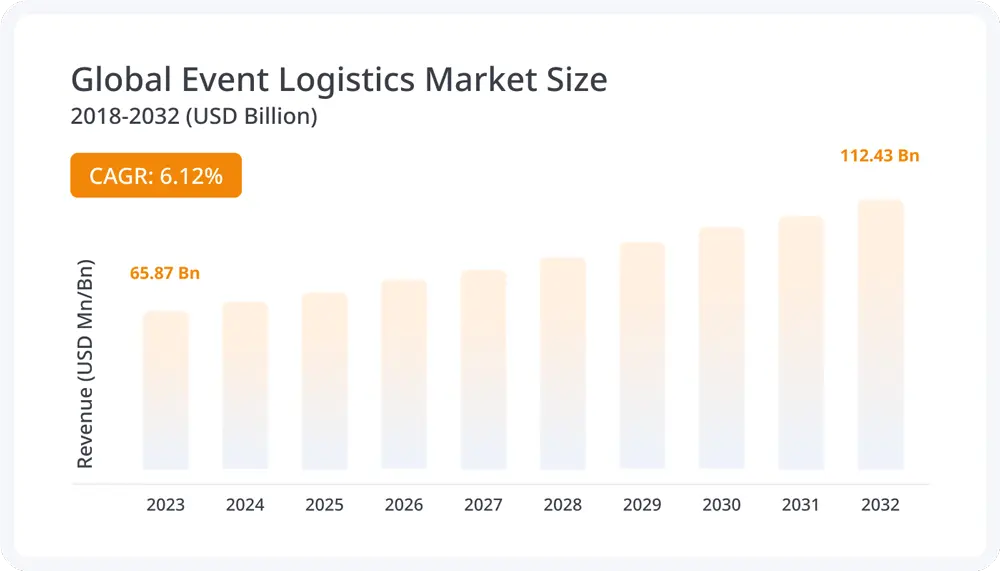
Source: Zion Market Research
The global event logistics market is expected to grow at around 6% annually, reaching more than 110 billion USD by 2032.
And that’s just the market size. Now imagine scaling event logistics across three countries at once.
The supply chain behind the World Cup
The World Cup is not just a sports tournament. It is a massive operation built on global supply chains and complex event logistics.
For the 2026 tournament:
- 48 national teams will compete.
- 16 cities will host matches.
- Millions of fans will travel across North America.
Behind the scenes, thousands of suppliers and logistics providers are coordinating everything from stadium operations to merchandise distribution.
Think about just one match.
Before kickoff, trucks deliver food and beverages for tens of thousands of people. Security equipment is installed and tested. Broadcast teams set up cameras, cables, and production stations. Medical teams prepare emergency facilities.
Merchandise arrives in boxes filled with jerseys, scarves, and flags for fans who want to support their teams. Every item you see in a stadium has traveled through a supply chain to get there. Coordinating all of this requires careful event logistics management, especially within tight security windows and limited storage space.
In many stadiums, deliveries can only happen during specific hours and through controlled access points. That means logistics teams must carefully schedule when trucks arrive, how quickly they unload, and where goods are stored.
A delay of even an hour can cause a ripple effect across the entire operation.
How the World Cup influences businesses worldwide
Events of this scale affect far more than stadiums. Even if your business has nothing to do with football, the World Cup can impact supply chains far beyond the event itself.
When millions of visitors arrive in a region within a short period of time, demand increases across hotels, restaurants, transportation services, and retail stores.
Suppliers move more goods, warehouses handle higher volumes, and transportation networks face additional pressure. This is where event logistics extends beyond the stadium itself.
With effective event logistics management, businesses can prepare for these temporary demand spikes and keep operations running smoothly during large global events like the World Cup.
Whether you are directly involved in the event or simply operating in the same region, you still need to plan for sudden changes in demand, capacity, and transportation.
Planning the tournament supply chain
Planning the supply chain for a global event like the World Cup is not as simple as ordering enough food or shipping enough jerseys. It requires careful event logistics management to design and optimize supply networks across multiple cities.
Organizers must decide where to store inventory, how to distribute goods between host cities, and how to ensure reliable deliveries under tight time constraints.
This is where supply chain design and optimization come into play.
For example:
- Where should warehouses be located to support multiple stadiums?
- How should inventory be distributed to avoid shortages or excess stock?
- What transportation routes minimize delays and costs?
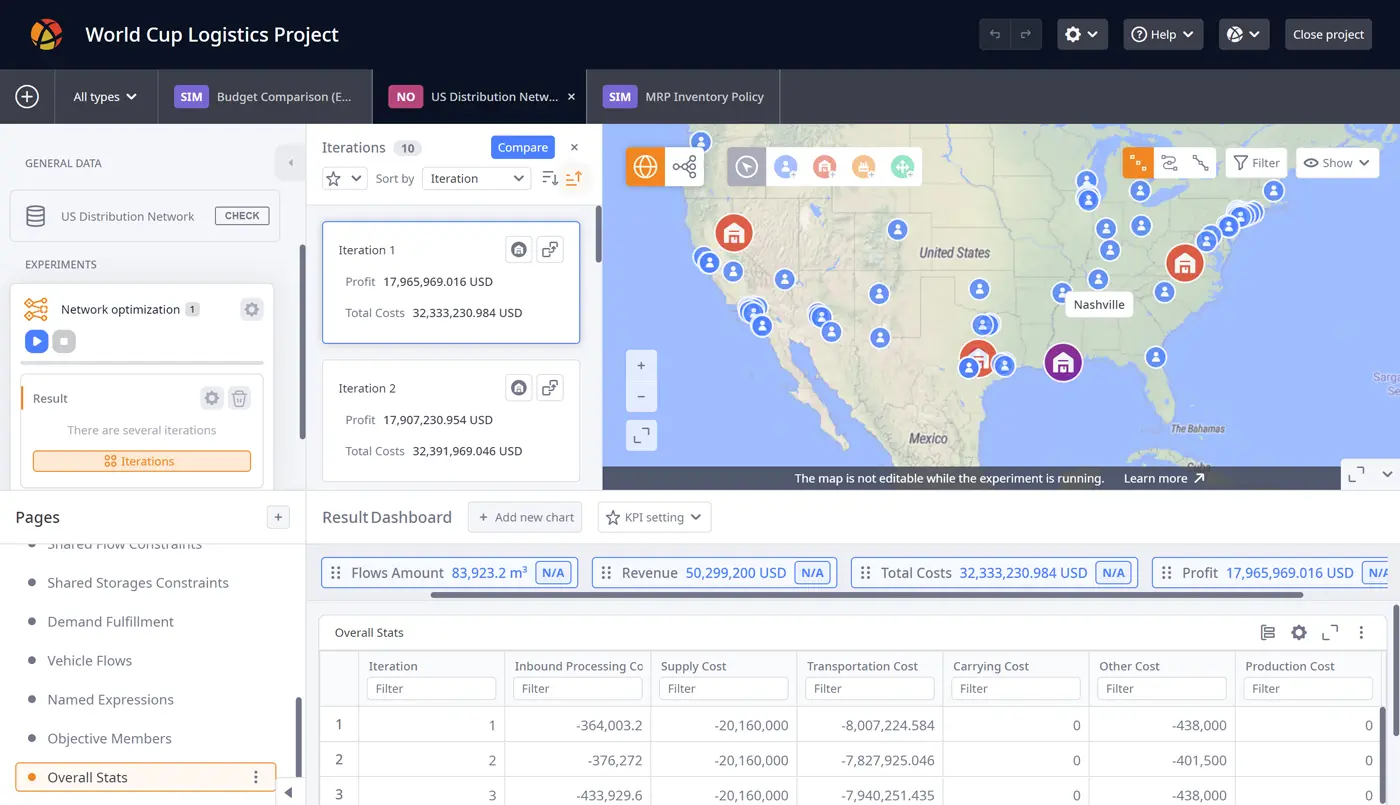
Last-mile optimization is especially critical. Supplies must arrive on time at stadiums, fan zones, and retail locations, often within strict delivery windows and limited access points. Optimizing routes and delivery schedules becomes essential to keep operations running smoothly.
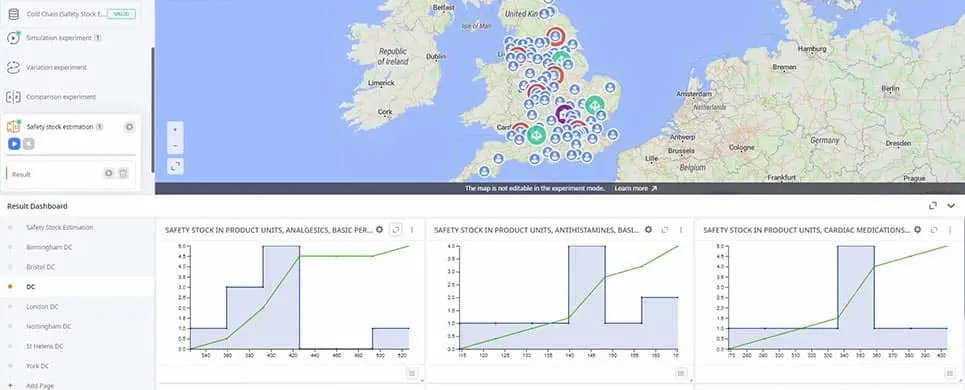
Another key challenge is the cold supply chain. Food, beverages, and medical supplies often require controlled temperature conditions. Any disruption in cold chain logistics can lead to product loss and service failures.
With the right tools, planners can design efficient supply networks, optimize inventory placement, and ensure reliable deliveries across all locations.
Network optimization experiment in anyLogistix (click to enlarge)
Why simulation matters in event logistics
Once the supply chain is designed, the next challenge is understanding how it will perform under real-world conditions.
When planning complex operations like a World Cup tournament, event logistics management quickly reaches the limits of spreadsheets. Too many variables interact at once, from transportation demand and delivery schedules to inventory levels across multiple cities.
Supply chain simulation becomes essential at this stage.
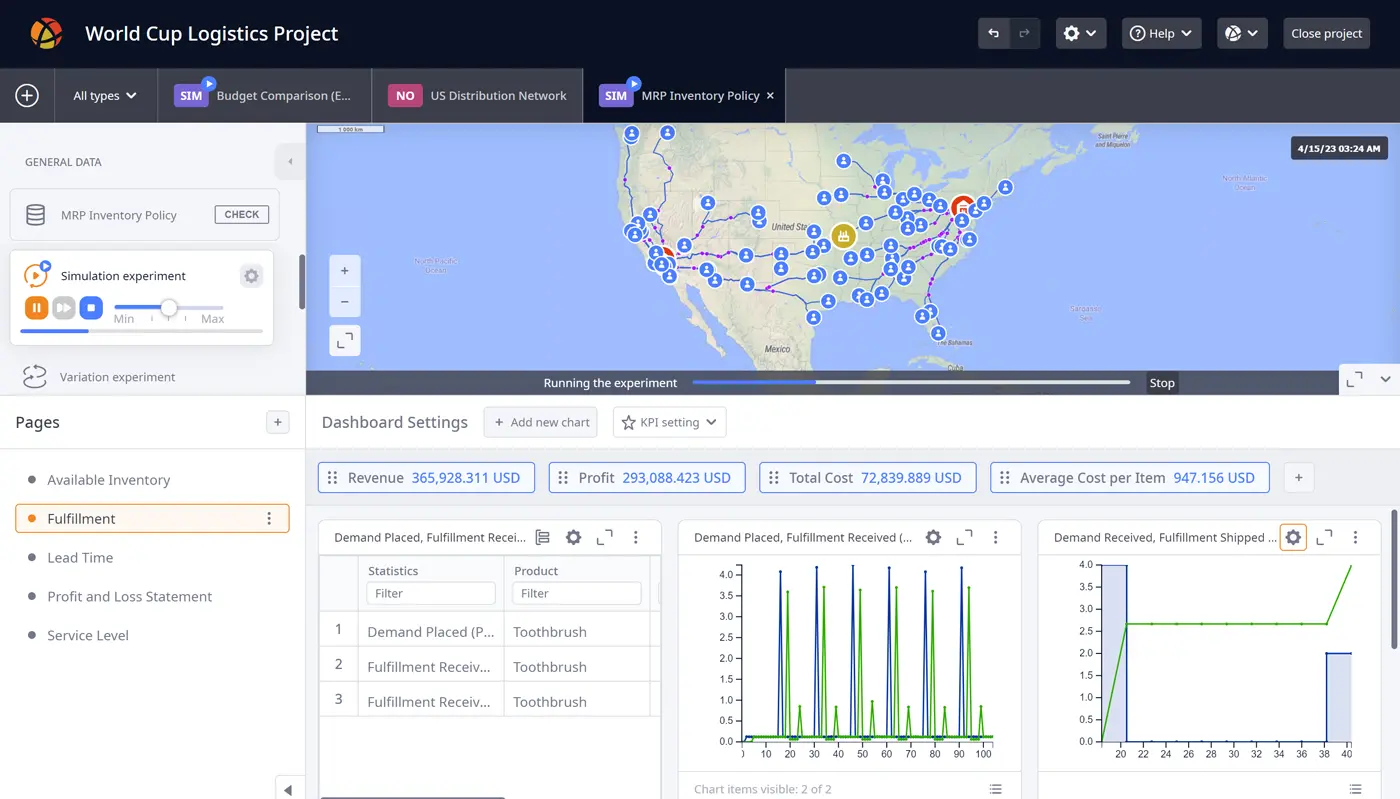
With tools like anyLogistix, planners can model supply chain behavior and test disruptions. They can also compare scenarios and see how changes in demand, inventory, or transportation affect performance before the event begins.
In practice, planners must deal with uncertainty across multiple dimensions, including demand fluctuations, transportation constraints, and operational risks.
For example:
- A popular team playing in a city may attract significantly larger crowds.
- A surprise tournament result can spike merchandise demand overnight.
- Weather conditions may disrupt transportation and delivery schedules.
These uncertainties can be explored and managed using simulation.
Inventory optimization
For large events, inventory decisions are critical. Too much stock leads to waste, while too little creates shortages during peak demand.
With anyLogistix, planners can test different inventory strategies across locations and find the right balance between service level and cost. For example, they can evaluate how much stock each host city needs based on expected demand.
Safety stock
Demand during events is unpredictable, which makes safety stock essential.
Simulation helps determine how much buffer stock is needed to maintain service levels even when demand spikes or deliveries are delayed. Instead of guessing, planners can calculate safety stock based on real scenarios.
Risk modeling and mitigation
Unexpected disruptions are unavoidable during events of this scale.
With supply chain simulation, planners can simulate risks such as transportation delays, sudden demand changes, or supply disruptions. They can test how the supply chain responds and identify ways to reduce impact before the event begins.
By running multiple scenarios in anyLogistix, teams can identify risks and improve plans before real operations begin.
Instead of reacting to disruptions during the event, they can prepare for them in advance.
Simulation experiment in anyLogistix (click to enlarge)
Tools for supply chain planning
Modern supply chain planning increasingly relies on advanced tools designed to model and optimize complex logistics systems used in event logistics.
anyLogistix combines supply chain design, risk analysis, and simulation capabilities in a single environment. With this tool, planners can explore different network configurations, evaluate transportation strategies, and test how supply chains respond to disruptions.
Instead of guessing how a system might behave, they can experiment with it virtually. For large-scale events with high uncertainty and complexity, that capability becomes incredibly valuable.
Interested in the technical capabilities of anyLogistix for supply chain simulation and optimization? Download our technical datasheet to explore its features.
The logistics victory nobody notices
When fans leave a World Cup match, they remember the goals, the atmosphere, and the drama.
They rarely think about how thousands of meals were delivered on time, how merchandise was stocked, or how transportation systems handled massive surges of people.
But that’s the nature of logistics. When it works perfectly, nobody notices, and for the teams behind the scenes, that’s the ultimate victory of effective event logistics management.
Try anyLogistix in your browser for free and experiment with real supply chain scenarios today!
try online