
Before building a supply chain model, define the objective in a clear statement:
We will make [decision] to achieve [business goal], measured by [KPI], within [scope and constraints], by [date].

This blog post is partially based on the presentation given at the anyLogistix Conference 2026 by Jean-Daniel Mathieu and Ershad Jahagirdar from SimWell.
Why do supply chain optimization projects fail? A model can be mathematically correct and still produce the wrong business recommendation.
The problem is often not the optimization algorithm itself, but the quality of the data, the assumptions behind the model, or the lack of alignment between the model and the business decision it is supposed to support.
The central message of this article is that successful supply chain optimization is a business alignment process, not just a mathematical exercise.
Use these six supply chain best practices to build reliable models, reduce project rework, and make confident network design decisions.
Contents:
One common mistake in supply chain optimization is building a model before agreeing on the business question it needs to answer.
Are you redesigning a distribution network, evaluating warehouse consolidation, comparing sourcing strategies, or assessing how the network will perform under demand growth? Each objective requires different data, assumptions, constraints, and performance metrics.
Before building a supply chain model, define the objective in a clear statement:
We will make [decision] to achieve [business goal], measured by [KPI], within [scope and constraints], by [date].
To make this objective actionable, agree on six elements:
This alignment keeps the project focused on a real business problem rather than building a model for its own sake.
Before translating a supply chain into a digital model, the team needs a shared understanding of how the network actually works.
Draw the supply chain with stakeholders before opening the modeling software. This simple exercise creates a shared reference for the model.
Map the key elements:
Keep the terminology the business uses, even when it differs from standard supply chain terminology. It is good practice to include in this sketch as much detail as possible and use it as a reference in the next stages of the project.
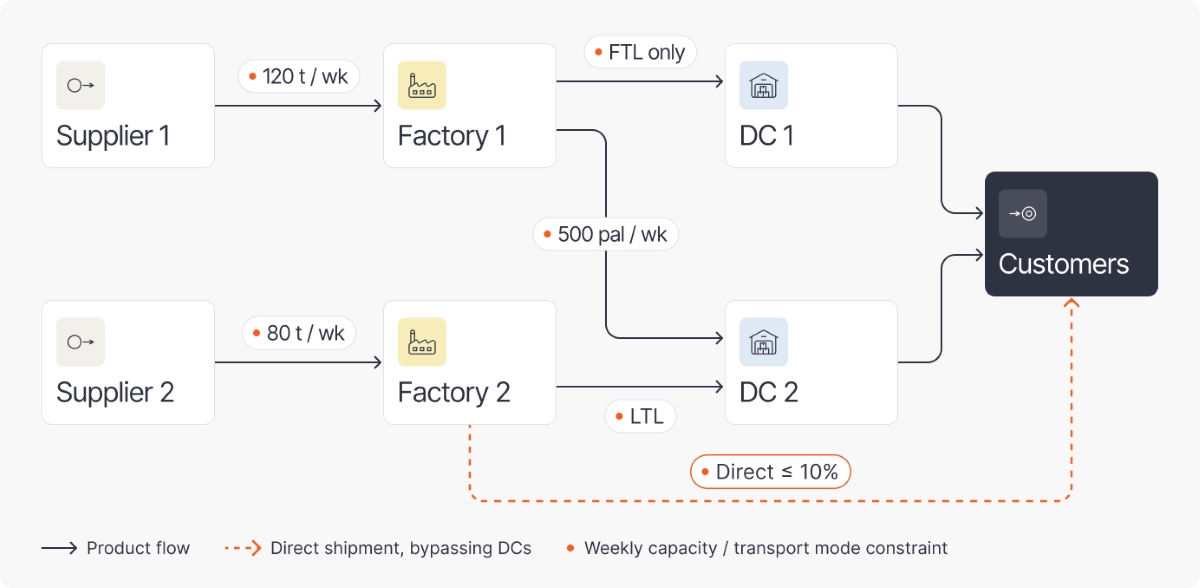
Example sketch of a supply chain with constraints (click to enlarge)
Supply chain data is often distributed across spreadsheets, uses inconsistent units, or contains missing values. A structured checklist should help make data explicit and traceable.
Typical data requirements include facility locations, product attributes, demand, production and distribution capacities, transportation costs, and sourcing rules.
For each data type, track four stages: discussed, received, verified, and validated.
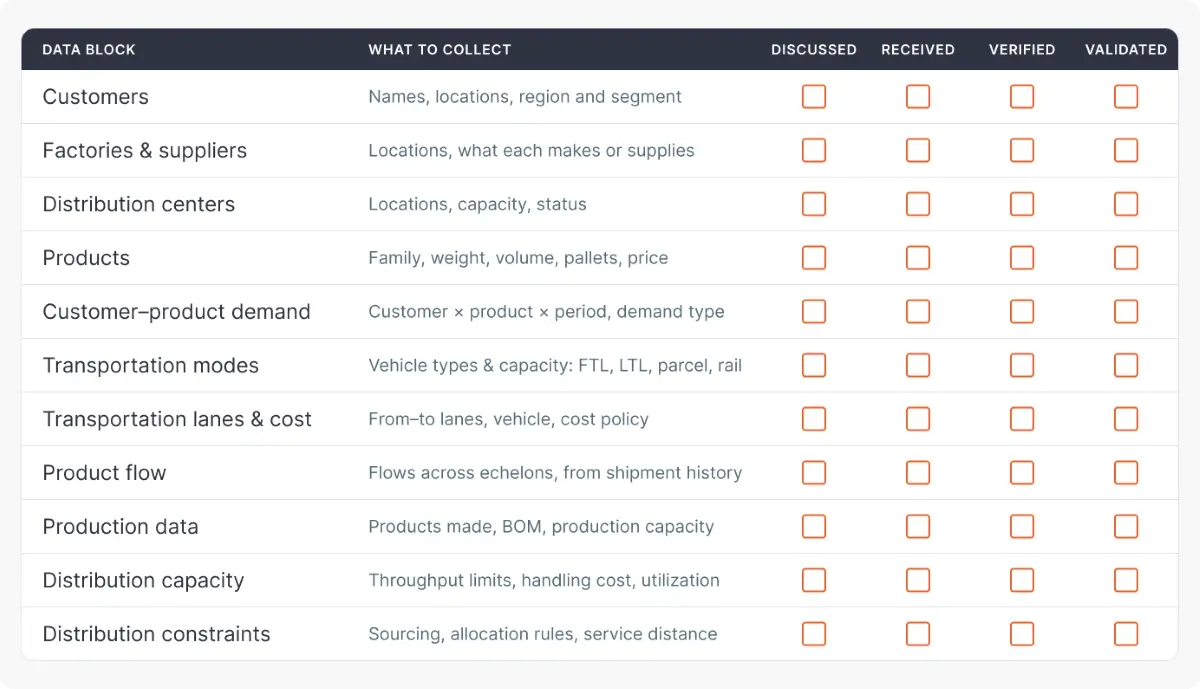
An example of a supply chain data checklist (click to enlarge)
A Sankey graph helps analysts understand historical product flows between suppliers, factories, distribution centers, and customers. Flow widths represent volumes, making it easier to identify major transportation corridors and unexpected movements.
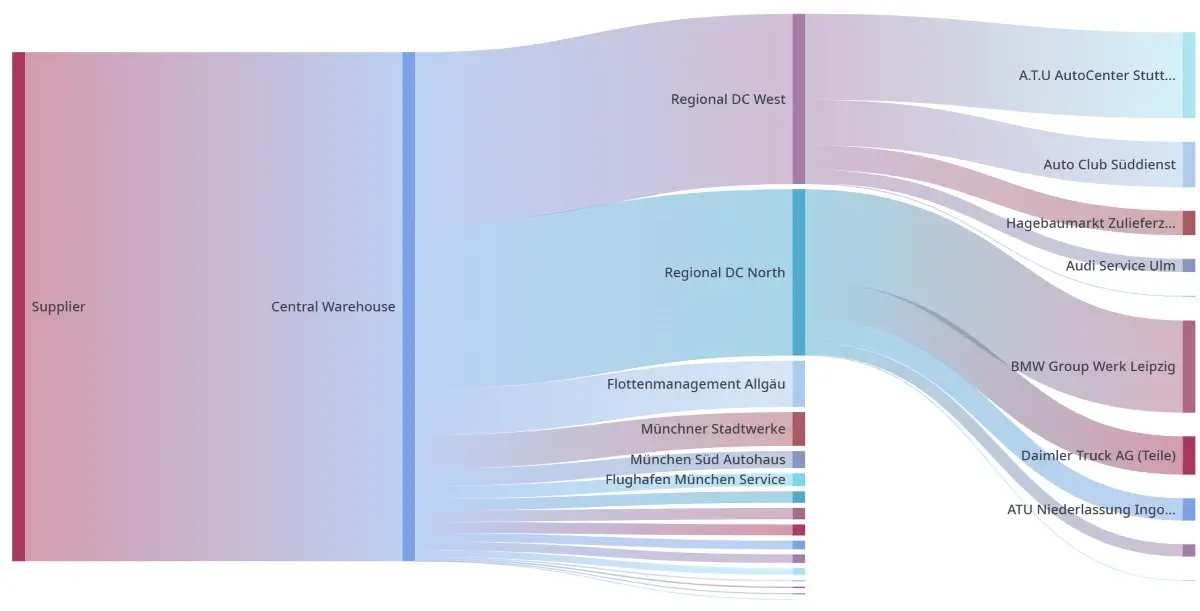
An example of a Sankey graph in anyLogistix (click to enlarge)
A visual representation of product flows can therefore accelerate initial analysis and help stakeholders validate the network structure. Explore the Sankey graph in anyLogistix Sandbox, where it is available to demonstrate the results of Cost to serve experiments.
An optimized network is only as credible as the baseline against which it is compared.
A baseline represents the current supply chain and provides the reference point for measuring potential improvements. It should include key aspects of actual performance. Compare the model's results with historical records and review them with the stakeholders responsible for the underlying data.
An optimization project from SimWell’s practice initially identified $4.2 million in potential savings through distribution center consolidation.
However, a review revealed that baseline transportation costs were off by 18% because less-than-truckload (LTL) rates had been modeled as full-truckload (FTL) rates on some of the highest-volume lanes.
After correcting the transportation logic, the estimated savings fell to $2.1 million.
The consolidation still made sense, but the financial justification changed significantly.
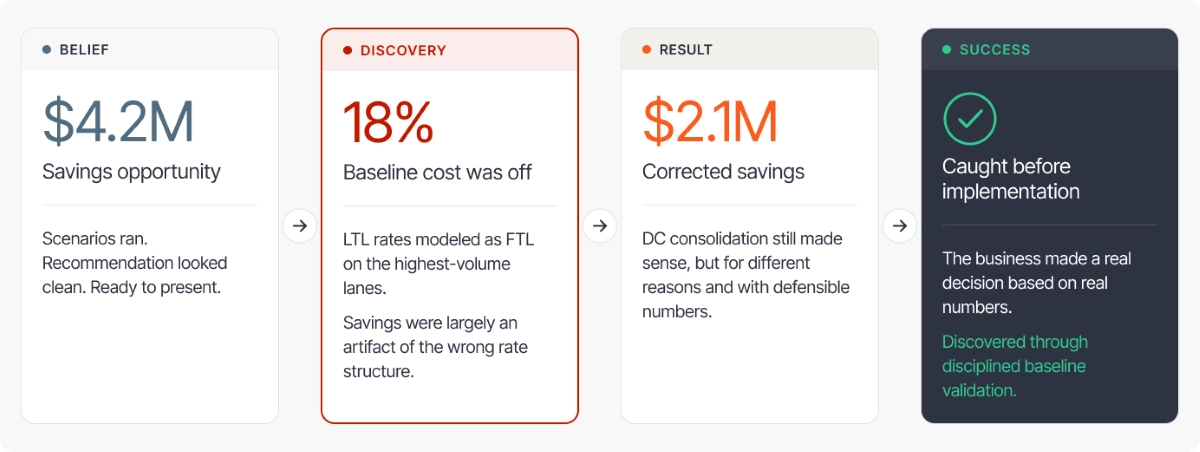
Catching an error thanks to a realistic baseline (click to enlarge)
Transportation modeling deserves particular attention in supply chain network design, as it can account for a significant share of the total project effort.
The challenge is not simply assigning a cost to each route. The model must reflect actual transportation policies, capacity rules, and cost structures. Vehicle capacity and product quantities should also use compatible units. For example, if truck capacity is expressed in cubic meters while product data is recorded in pallets or individual units, the model needs the appropriate conversion.
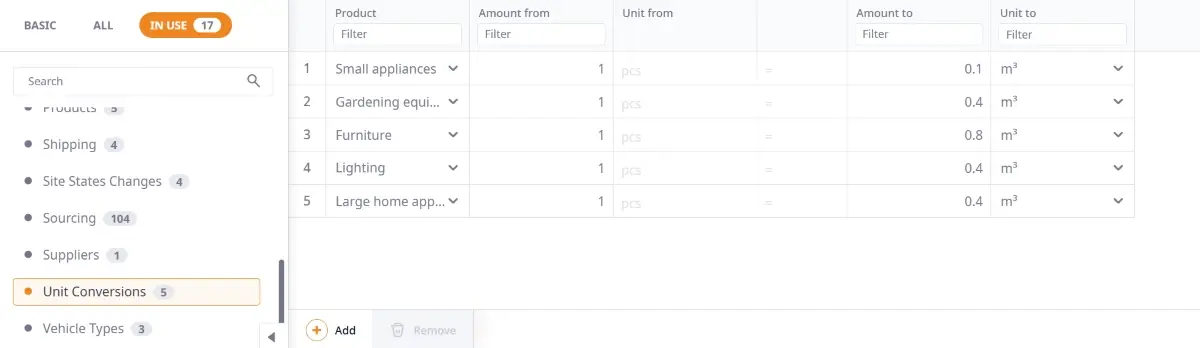
Setting up unit conversions in anyLogistix (click to enlarge)
Network optimization experiments in anyLogistix can also introduce routes that do not exist in the current supply chain. Historical rates are therefore unavailable for some proposed movements. In such cases, use one of the following approaches:
For last-mile delivery optimization, use the dedicated experiment in anyLogistix to plan efficient routes from distribution centers, warehouses, or factories to end customers. This capability enables you to minimize total driving time, improve delivery performance, and evaluate trade-offs between transportation costs, service levels, and fleet resources.

Last-mile optimization experiment in anyLogistix (click to enlarge)
Even after data preparation and transportation modeling, the first optimization run may fail to produce a feasible solution. Conflicting constraints may prevent the model from finding an optimal result.
For example, a distribution center may appear to ship more products than it receives, a transportation route may be missing, or a facility's capacity may be incorrectly specified.
That is why it is so important to use both hard and soft constraints in your optimization projects. Take a quick look at the differences between these two below.

Key differences between hard and soft constraints
The good news is that you can set all your custom constraints in anyLogistix. The platform allows you to incorporate specific business rules into supply chain optimization models: conditions for the existing product flows, product storage, and production limitations. This helps align the model with real-world conditions and the organization's priorities.
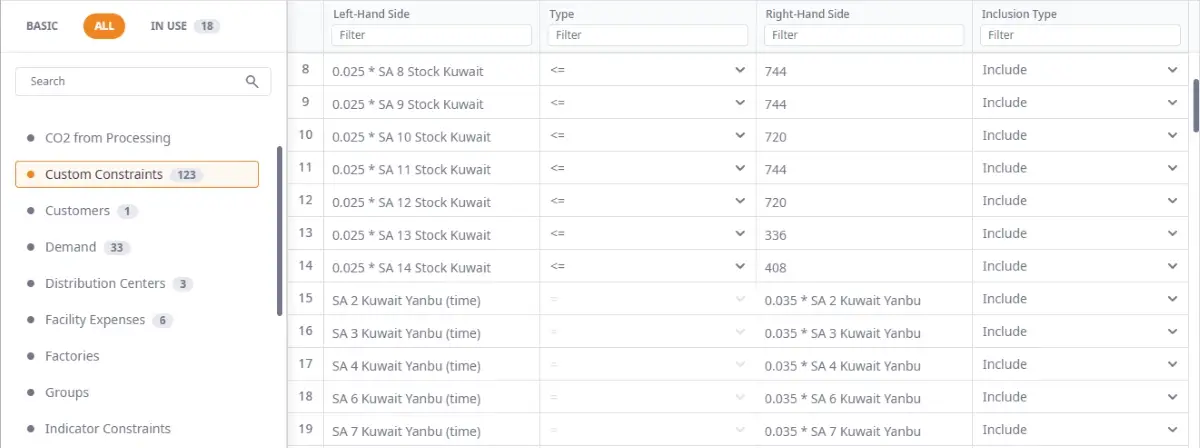
Setting up custom constraints in anyLogistix (click to enlarge)
Once you have set up all model parameters and completed the preceding steps, it is time to evaluate alternative network designs.
Each scenario should answer a specific business question rather than simply test what the software can calculate. Here are some real questions around which you can build your optimization scenarios:
For every scenario, compare the results with the validated baseline and the original business objectives.
Use anyLogistix’s side-by-side comparison to evaluate outcomes in one table. Review not only total cost but also relevant trade-offs, such as service levels, lead times, capacity utilization, and emissions.

Side-by-side comparison table in anyLogistix (click to enlarge)
Watch the full conference presentation on supply chain management best practices by SimWell experts. The slides are available as a PDF.

Supply chain management best practices are most valuable when they connect reliable analysis with decisions that can be implemented.
Accurate optimization is essential, but it is only one part of effective supply chain management. Clear objectives, reliable data, realistic transportation costs, a validated baseline, and transparent scenario analysis are equally important.
anyLogistix supports network design and optimization by enabling organizations to model their supply chains, evaluate alternative network configurations, and compare scenarios before implementing changes in the real world.
By applying these supply chain best practices, teams can move beyond theoretical savings toward recommendations grounded in operational and business realities.
Ready to put these supply chain management best practices into action? Try anyLogistix Sandbox.