This blog post is partially based on the presentation given at the anyLogistix Conference 2026 by Prof. Dr. Dr. habil. Dmitry Ivanov from the Berlin School of Economics and Law.
Supply chain simulation has traditionally been used to answer a fundamental question: What happens if we change something in the supply chain?
Simulation makes it possible to test these scenarios virtually before making decisions in the real world. But artificial intelligence is changing what a simulation model can do and how people interact with it.
Instead of using simulation only as an offline analytical tool, companies are moving toward digital supply chain twins that combine models, real-world data, analytics, and AI. The next step is the emergence of agentic digital twins, where AI agents can interact with models, analyze results, adapt scenarios, and support and increasingly automate supply chain decisions. This is the foundation for AI agents in supply chain applications that can move from analysis to coordinated decision support.
Contents:
Simulation remains one of the most powerful ways to understand supply chain dynamics.
Unlike purely analytical approaches, simulation allows supply chain professionals to experiment with a representation of the real system and observe how its behavior changes under different conditions.
For supply chain management, this approach is particularly valuable because supply chains are dynamic systems. Inventory policies, transportation lead times, production capacity, demand variability, disruptions, and interactions between supply chain partners can all affect the outcome.
AI adds another dimension to this process. According to Prof. Dmitry Ivanov, the integration of AI and simulation is developing in three major directions:
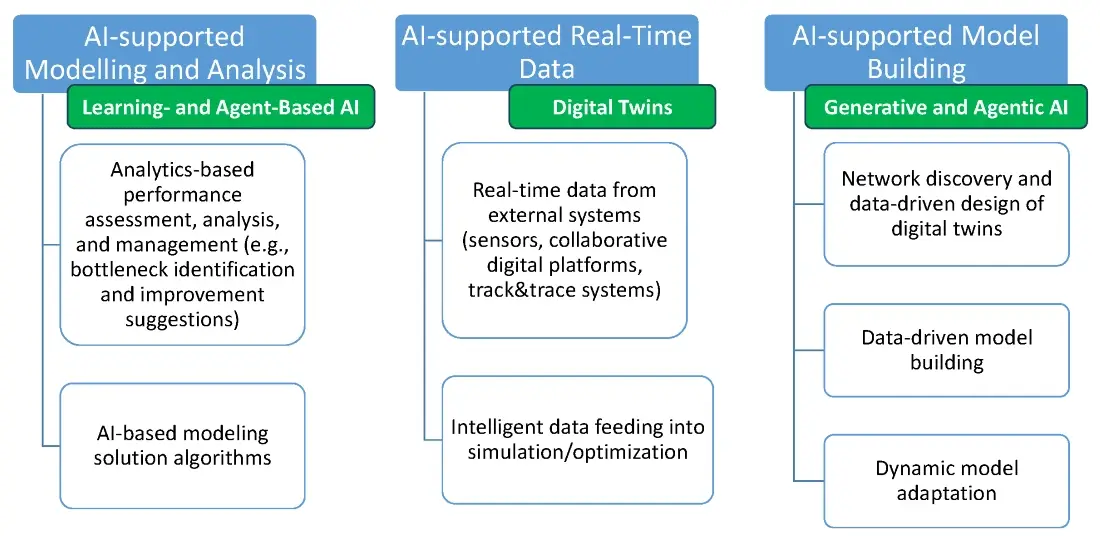
Directions of simulation and AI integration (click to enlarge)
This evolution shifts simulation from a model periodically updated by analysts to a system that can increasingly learn, interact, and adapt.
The concept of a supply chain digital twin is not new. In an earlier presentation, Prof. Dmitry Ivanov described digital twins as systems combining a digital representation of the supply chain, technologies that provide data about the physical system, and analytics to support decision-making.
The latest presentation takes this concept further. A digital twin can become the foundation for connecting multiple technologies and analytical capabilities: supply chain data, optimization, simulation, machine learning, generative AI, process mining, and AI agents.
A simulation model helps you experiment with a supply chain. A digital twin connects that model to the real supply chain and its data. AI can then make the interaction with the model more intelligent and adaptive.
The rise of generative AI might suggest that traditional simulation models could become less important. The opposite may be true.
Generative AI in the supply chain can provide recommendations, identify patterns, summarize information, and interact with users in natural language. But supply chain decisions still need to be tested against the behavior of the underlying system.
This is where simulation provides a critical layer of validation.
For example, an optimization model may identify an attractive supply chain configuration under idealized assumptions. A simulation can then test the actual performance of that configuration by considering lead times, inventory policies, demand variability, and operational constraints.
In an AI-enabled environment, this makes simulation less of a standalone analytical technique and more of a validation and experimentation engine for AI-driven decisions.
One of the most practical parts of Ivanov's presentation is the demonstration of how generative AI in the supply chain could change the way professionals work with simulation models.
Today, working with a simulation model often requires understanding its structure, parameters, experiments, and outputs.
Generative AI in supply chains can provide a natural language interface. Instead of manually configuring every experiment, a supply chain manager could ask questions such as:
AI agents in supply chain workflows can make this interaction more accessible by translating business questions into model-based analysis.
This changes the role of simulation from something used primarily by modeling specialists to something that can become more accessible to supply chain decision-makers.
Simulation can produce enormous amounts of data. The challenge is often not generating it but understanding why the results look the way they do.
AI can assist by analyzing simulation outputs, identifying potential problems, and explaining relationships between model parameters and performance.
In Ivanov's example, an AI assistant can inspect reorder-point settings, identify that they are inappropriate, explain the expected impact on service levels, and suggest alternative values.
This is an important shift: AI does not replace the simulation experiment. It helps people understand the results of the experiment. That distinction is likely to remain important as AI becomes more deeply integrated into supply chain analytics. For AI agents in supply chain applications, this reasoning layer can help connect simulation results with practical recommendations while keeping human experts in the loop.
Supply chain managers often think in terms of business events, not model parameters.
For example:
"Stress-test my supply chain against a global energy crisis."
A scenario like this can involve multiple simultaneous effects: higher electricity and diesel prices, inflation, reduced consumer spending, increased production costs, and more expensive transportation.
Generative AI in the supply chain can translate this business narrative into a structured disruption scenario and create the corresponding events in a simulation model. The model can then be used to stress-test the supply chain under the scenario.
This creates a powerful interface between business reasoning and supply chain simulation.
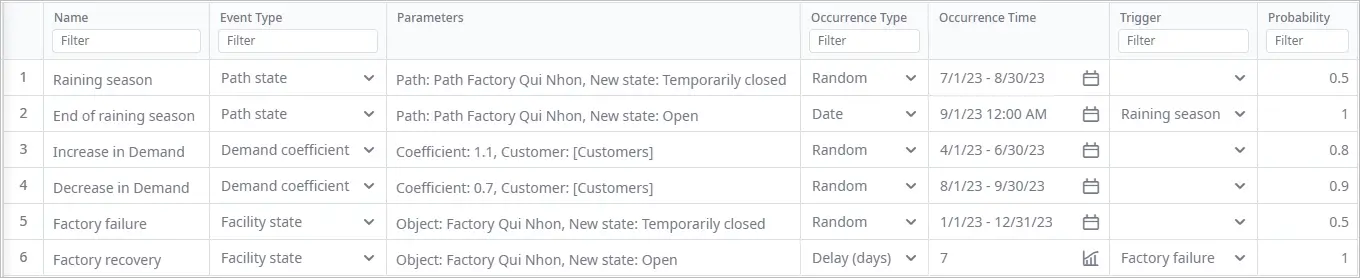
Disruption scenarios in anyLogistix (click to enlarge)
One of the biggest challenges in building a supply chain digital twin is visibility.
Companies usually have much better information about their own operations and direct suppliers than about deeper tiers of the supply network. Ivanov's Ford case study illustrates this through a three-level digital twin framework covering the intracompany supply chain, Tier 1 network, and deeper-tier network.
As visibility decreases, building an accurate digital twin becomes more difficult. This is where AI can help with what Ivanov calls network illumination.
Generative AI and other data-driven techniques can help discover and interpret information about the broader supply network. Combined with simulation, this can support disruption identification, impact assessment, scenario analysis, and mitigation strategy development.
For supply chain resilience, this combination is particularly valuable. A disruption does not need to be fully understood before it can be modeled. AI can help identify and structure the event, while simulation can help answer the more difficult question: What happens to the supply chain if this disruption occurs?
Another major change is the move from isolated analytical functions toward orchestration.
Traditional supply chain management often separates activities into functions such as demand planning, material requirements planning, production planning, inventory management, transportation, and sourcing.
Agentic AI opens the possibility of coordinating these activities dynamically. In Ivanov's framework, data from systems such as ERP, MRP, TMS, WMS, IoT, and third-party sources can feed a common environment. AI agents can then interact with simulation and optimization models while coordinating decisions across areas such as inventory, transportation, sourcing, and production.
In an agentic AI supply chain, these agents can coordinate decisions across functions while using simulation and optimization to evaluate alternatives before action. This is where supply chain simulation becomes part of a broader decision-making ecosystem.
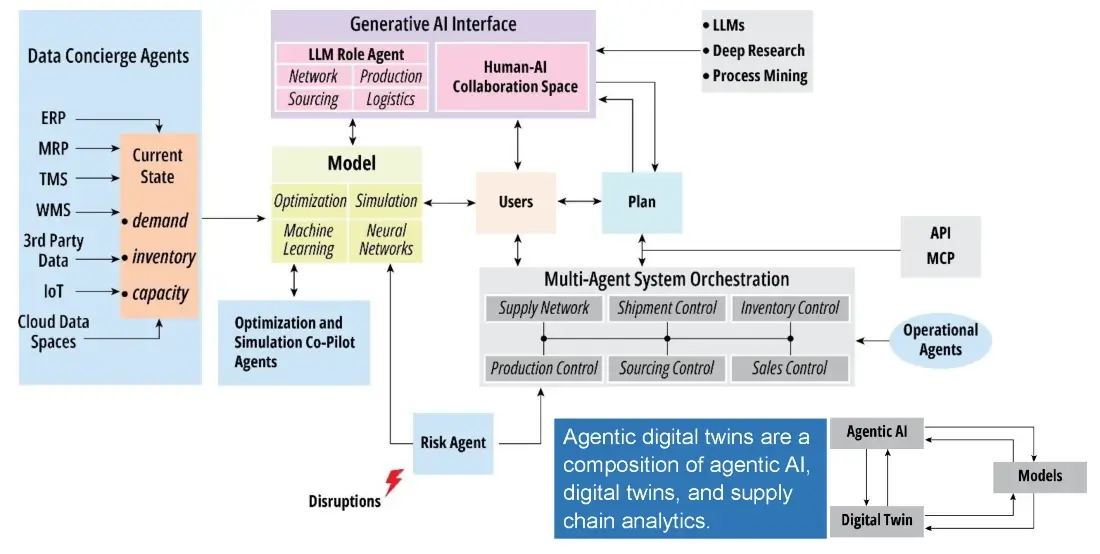
Agentic AI supply chain – bridging model-based and AI-powered methods (click to enlarge)
Instead of asking a simulation model one question at a time, multiple AI agents can use models to evaluate alternatives, stress-test plans, and provide recommendations within a coordinated workflow.
To gain more insights about agentic AI supply chains, watch the video below of Prof. Dmitry Ivanov's presentation at the anyLogistix Conference 2026.
This evolution does not make simulation and optimization outdated. It makes their role more important.
In Ivanov's vision, anyLogistix occupies the operational analytics layer of a broader digital twin architecture, alongside optimization and simulation models. Generative AI, learning-based AI, agentic AI, and other analytical technologies can interact with this modeling layer.
This creates a useful division of responsibilities:
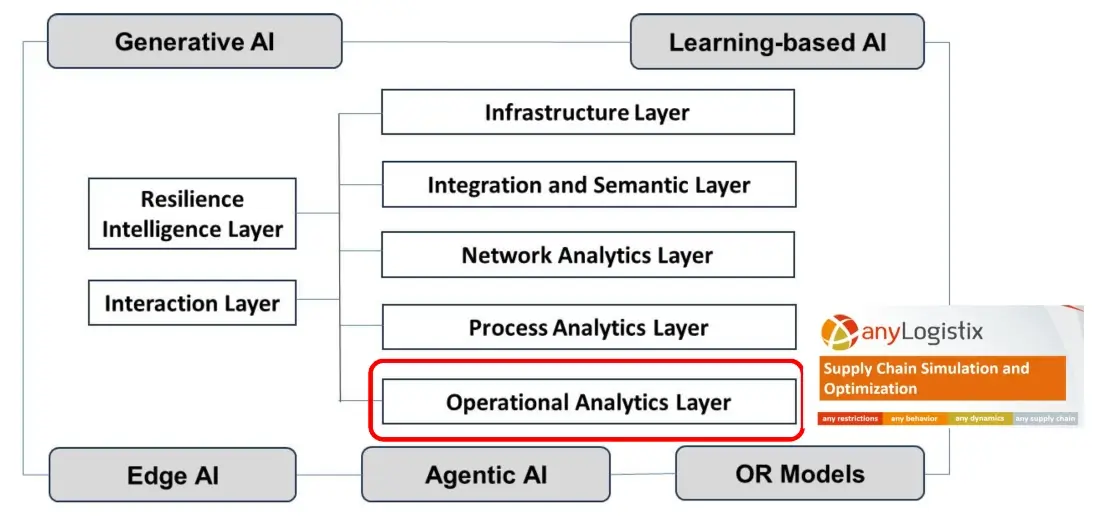
Digital twin technology: simulation-AI symbiosis (click to enlarge)
The transition toward AI-powered digital twins is already underway, but technology is still evolving.
For supply chain leaders, the practical question is therefore not whether AI will affect supply chain simulation. It is how to combine AI with reliable models, real-world data, and human expertise to improve decisions.
This is where platforms such as anyLogistix can play an important role.
A simulation model can provide the operational foundation. A digital twin can connect it to the real supply chain. AI can make the system more interactive, adaptive, and intelligent. AI agents in supply chain systems can connect data, models, and decisions across the wider supply chain ecosystem.
The future of supply chain simulation may therefore be less about building increasingly sophisticated standalone models and more about making those models active participants in an AI-powered supply chain.
The emerging ecosystem is built around continuous collaboration between humans and AI, with simulation playing a central role.
Ready to explore how simulation can support supply chain decision-making? Try anyLogistix Sandbox to build digital supply chain models, test what-if scenarios, evaluate risks, and compare optimization strategies in a risk-free environment. See how simulation and optimization can become a practical foundation for agentic AI supply chain decision-making.